7 · How do you know it's right?
Every chapter so far has quoted an impedance to a tenth of an ohm as if it were handed down. It wasn’t — it’s the output of code we wrote, and there is no closed-form dipole impedance to check it against. So how does anyone trust a method-of-moments number? Two cross-examinations, and a solver has to pass both.
Internal: does it stop moving?
Section titled “Internal: does it stop moving?”The first is cheap and necessary: a converged answer stops changing as you add unknowns. Refine the mesh; if the impedance keeps wandering, you haven’t found the antenna’s number, you’ve found a number for this mesh.
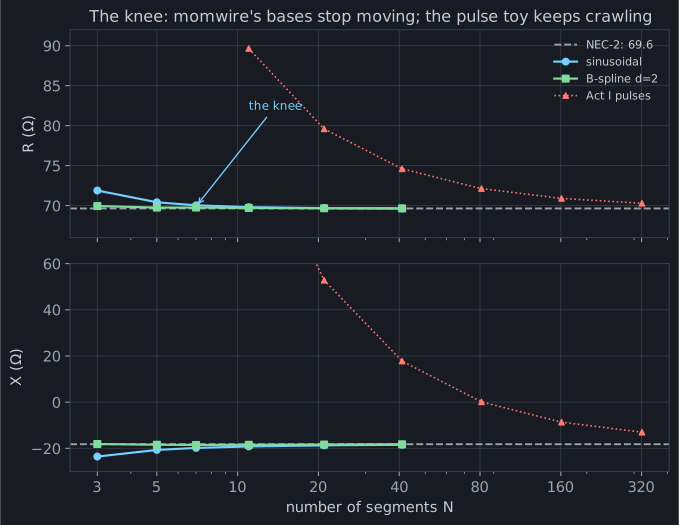
momwire’s good bases hit the knee by five to seven segments and then sit still — that flat line is what convergence looks like. The Act I pulse toy, on the same axes, is still crawling at three hundred. That contrast is the whole of Acts I–II in one picture: continuity buys you a knee.
But convergence is necessary, not sufficient. A solver can march confidently to a stable, wrong answer — a consistent bug, a subtly mis-derived kernel, a basis too crude to resolve the near field (we watched exactly that in chapter 3, where the pulse’s reactance converged about an ohm shy of a continuous basis). A method agreeing with itself proves only that it’s self-consistent. For the truth you need a witness who shares none of your code.
External: does an unrelated engine agree?
Section titled “External: does an unrelated engine agree?”That witness is NEC-2 — the reference wire solver of the last forty years, via
PyNEC. It’s an independent implementation with its own kernel, its own testing,
its own everything. When momwire and NEC agree on an antenna, the agreement
can’t be a shared bug, because they share no code. Here is momwire’s sinusoidal
and B-spline solver against NEC-2 on two antennas — the specimen dipole and a
two-element Yagi (docs/convergence_analysis.md):
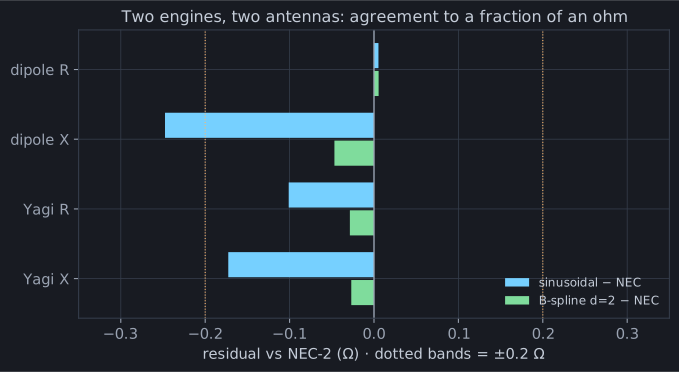
Two engines, two antennas, two of momwire’s own bases — everything lands inside
a few tenths of an ohm, and the B-spline solver inside a twentieth. The Yagi is
the sterner test: a parasitic element with no feed of its own, its current
induced entirely by the driver, coupling through the near field. Getting
77.25 + 6.71j against NEC’s 77.28 + 6.74j means the mutual coupling, not
just the self-impedance, is right.
The honest part
Section titled “The honest part”The bars aren’t all zero, and that’s the honest part worth dwelling on. Two
different discretizations of the same continuous problem — a sinusoidal basis
with collocation, a B-spline basis with Galerkin — can converge to values a
fraction of an ohm apart, because they are different finite approximations, not
the exact integral. Neither is “wrong.” The sinusoidal solver’s slightly larger
reactance residual is real, and it shrinks as N grows past 41.
Which is exactly why the cross-check matters, and why momwire carries both bases plus the NEC comparison rather than trusting one. The sinusoidal solver sharing NEC’s basis makes it a tight ruler — a tenth of an ohm — but a ruler that agrees with a copy of itself is only so convincing. The real evidence is the B-spline solver: a completely different basis, a completely different testing scheme, landing on the same answer. When two methods that share nothing but the physics agree, the thing they agree on is the physics.
Act II, closed
Section titled “Act II, closed”You now have the craft, and a reason to trust it:
- continuous bases — sinusoidal (ch. 4) and B-spline (ch. 5) — converge in a handful of segments where the pulse crawled for hundreds;
- honest quadrature (ch. 6) fills the matrix accurately, splitting the smooth pairs from the singular ones;
- and convergence plus cross-validation (ch. 7) turn the output into evidence.
That is a trustworthy free-space wire solver. Act III raises the stakes to where real antennas live: above the ground — first as a perfect mirror, then as real, lossy dirt, and finally paying Sommerfeld’s full price for getting it exactly right.